

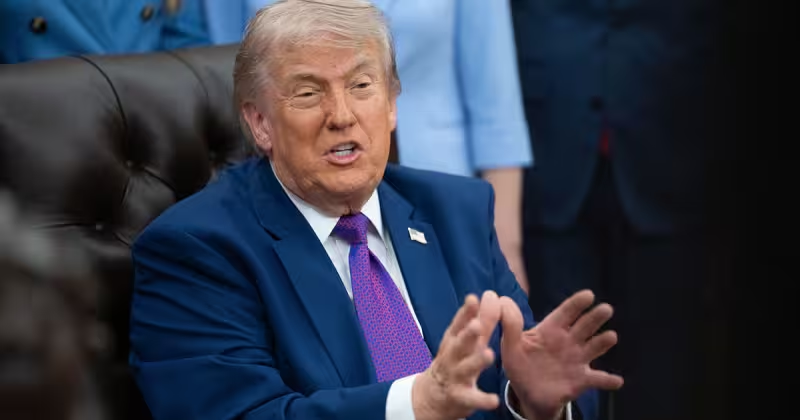
Delcy Rodríguez said on Monday that Venezuela had no plans to become the 51st U.S. state, pushing back after Donald Trump said he was seriously considering the idea. She made the comment in The Hague on the final day of hearings at the International Court of Justice in the long-running dispute between Venezuela and Guyana over the Essequibo region.
Rodríguez said Venezuela would keep defending its integrity, sovereignty, independence and history. “We are not a colony, but a free country,” she said, adding that Venezuelan and U.S. officials have been in touch and are working on cooperation and understanding.
The exchange came as White House spokesperson Anna Kelly declined to comment on Trump’s plans in an interview with John Roberts on. Kelly said Trump was “famous for never accepting the status quo” and praised Rodríguez for working “incredibly cooperatively” with the United States.
The dispute centers on Essequibo, a 62,000-square-mile territory that makes up two-thirds of Guyana and sits near offshore oil deposits producing an average of 900,000 barrels a day. Venezuela produces about 1 million barrels of oil a day itself, underscoring how much of the confrontation now sits at the intersection of sovereignty and energy.
The border was drawn in 1899 by arbitrators from Britain, Russia and the United States, largely in Guyana’s favor along the Essequibo River. Venezuela argues that a 1966 agreement in Geneva effectively nullified that ruling. Guyana took the fight to the International Court of Justice in 2018, after ExxonMobil announced a significant oil discovery off the Essequibo coast.
Tensions flared again in 2023 after Nicolás Maduro threatened to annex the region by force following a referendum on whether Essequibo should be turned into a Venezuelan state. The territory has long been claimed by Venezuela, which has considered it its own since the Spanish colonial period, but Guyana’s offshore oil boom has turned it into one of the region’s most consequential flash points.
Rodríguez assumed power in January after a U.S. military operation ousted Maduro. Maduro was captured on Jan. 3 during a U.S. military operation in Caracas and taken to New York to face drug trafficking charges. She met U.S. Energy Secretary Chris Wright at Miraflores Palace in Caracas on Feb. 11, 2026, a reminder that even as the two sides clash over territory, their governments are still finding reasons to talk.
For now, the clearest answer from The Hague is also the simplest: Venezuela is not looking to become part of the United States, even as its leadership continues to test how far a once-regional border fight can reach.