


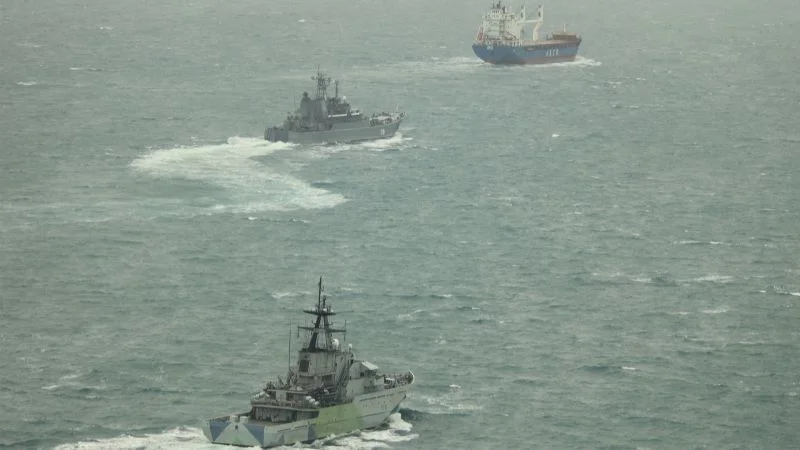
Britain’s Royal Navy tracked a Russian frigate every day last month as it sailed from the Atlantic to the North Sea, in one of the clearest signs yet that Moscow is keeping warships close to its shadow fleet routes. The frigate, Admiral Grigorovich, also escorted six Russia-linked vessels during April, while four UK ships and helicopters watched it continuously.
The Russian frigate was able to stay near Britain by taking on supplies near Galloper windfarm off the Suffolk coast, according to the facts released on the patrol. At the end of the month, a second frigate, Admiral Kasatonov, passed through the Channel escorting two merchant ships believed to be heading towards Tartus in Syria, including the Sparta, which is associated with the transport of arms. The convoy was monitored by the British auxiliary ship RFA Tideforce.
The April patrols came after Keir Starmer said on 25 March that the military would be able to seize ships subject to existing economic sanctions that were transiting through UK waters, and that Britain would go after Vladimir Putin’s shadow fleet even harder. One month later, the message from the sea was more complicated. The UK had not led the seizure of any shadow fleet tankers since the announcement, even as Russia put frigates in the middle of commercial traffic.
Elisabeth Braw said the escort pattern showed a level of protection that is not normal for merchant shipping. “This is completely disproportionate; navies normally only escort vessels when there is a clear military threat, such as from the Houthis in the Red Sea,” she said. She added that Russia had made clear the trade was valuable enough to defend: “Russia has decided that this is an indispensable source of income that could be disrupted. Clearly, if the Russians thought these vessels were not going to encounter problems, they would not allocate a frigate.”
The broader contest has sharpened in the North Sea after UK threats to clamp down on the shadow fleet, the old and often poorly maintained tankers Russia uses under third-country flags of convenience for roughly half its seaborne oil exports. France has seized two Russia-linked tankers with UK assistance this year, and Sweden has detained five tankers this year as well. On Sunday, Sweden boarded the Jin Hui on suspicion of flying under a false flag.
There is also a risk in the pattern itself. Braw said Russia’s willingness to use its navy to shield rule-breaking vessels makes it harder for coastal states to act, because any intervention raises the chance of a confrontation with the escort. That is the logic now hanging over the waters off Britain: the more Moscow relies on warships to protect the trade, the harder it becomes for anyone else to stop it without a standoff.
John Healey said a month ago that the British navy had followed three Russian submarines on a month-long mission sailing over pipelines and cables near UK waters. Taken together with April’s frigate patrols, the message from Moscow appears less about stealth than persistence. Britain says it is prepared to act; Russia is sending warships to make sure the trade keeps moving.