

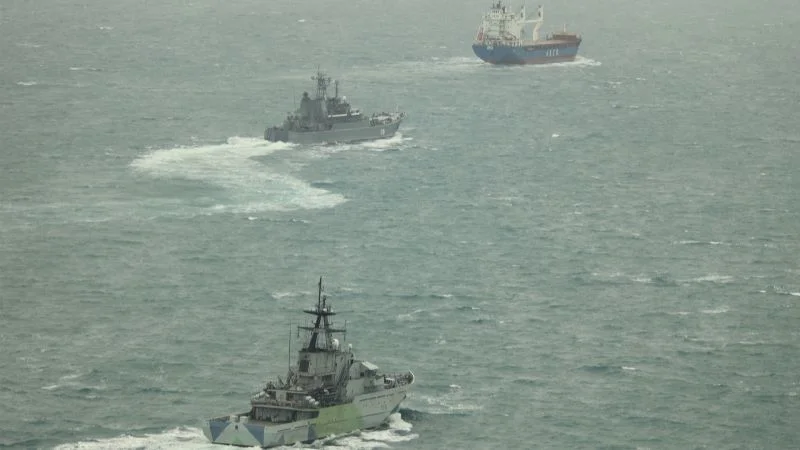
Britain’s Royal Navy tracked and followed a Russian frigate every day last month as it sailed from the Atlantic to the North Sea, a sign of how far Moscow is now going to shield vessels tied to its oil trade. The frigate, Admiral Grigorovich, moved close enough to Britain to keep its presence near the coast by taking on supplies near Galloper windfarm off Suffolk.
During April, Admiral Grigorovich escorted six Russia-linked vessels, including at least three sanctioned ships that passed east through the Dover strait while being watched continuously by four UK ships and helicopters. A second frigate, Admiral Kasatonov, then passed through the Channel towards the end of the month, escorting two merchant ships believed to be heading for Tartus in Syria, including the Sparta, a vessel associated with the transport of arms. The convoy was monitored by the British auxiliary ship RFA Tideforce.
The pattern matters because it came after Keir Starmer said on 25 March that the military would be able to seize ships subject to existing economic sanctions transiting through UK waters, part of a push to make the russian shadow fleet “even harder” to use and to hit what he called “Putin’s war machine of the dirty profits that fund his barbaric campaign in Ukraine.” Since that statement, Britain has not led the seizure of any shadow fleet tankers.

Russia relies on the shadow fleet of often old, poorly maintained tankers sailing under third-country flags of convenience for roughly half its seaborne oil exports, and the naval cover now being offered suggests Moscow sees the route as too important to leave unguarded. Elisabeth Braw said the escorting was “completely disproportionate” and that navies normally only guard vessels when there is a clear military threat, such as from the Houthis in the Red Sea. She said Russia had decided this was an indispensable source of income that could be disrupted, and that the decision to send a frigate showed the Kremlin did not expect the ships to move through without challenge.
She also said Russia had shown it was willing to use naval power to protect vessels that break maritime rules, making it harder for coastal states to intervene because they must be ready to risk a confrontation with the escort. That warning lands at a moment when other European countries are already moving more aggressively: Sweden has detained five tankers this year, and France has seized two Russia-linked tankers with UK assistance. Naval tensions between London and Moscow have increased, and Russia’s presence near Britain has grown after UK threats to seize shadow fleet oil tankers.
The immediate question is whether Britain will now act on the authority Starmer described, or whether the sight of Russian frigates in nearby waters will keep doing what the tankers themselves are designed to do: keep the flow moving.