


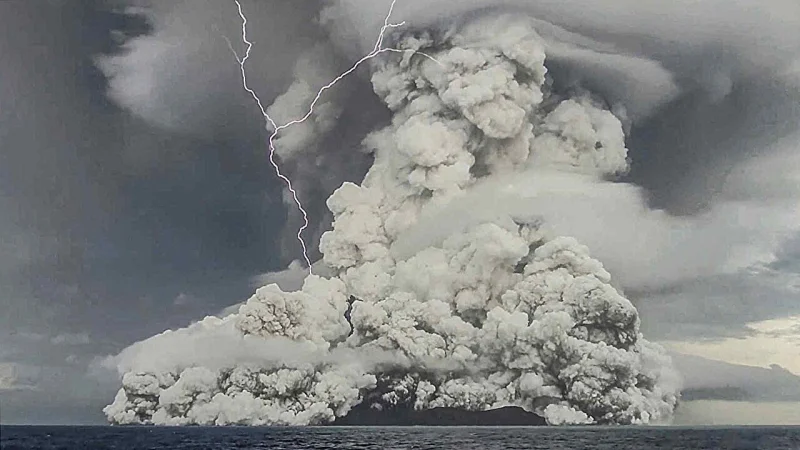
When Hunga Tonga–Hunga Ha'apai erupted in January 2022, it blasted a vast plume high over the South Pacific. Researchers later found something unexpected inside it: unusually high concentrations of formaldehyde, a sign that the cloud was destroying methane as it drifted for days across the sky.
The satellite cloud was tracked for 10 days all the way to South America, and because formaldehyde lasts only a few hours, the researchers concluded the plume must have been stripping methane continuously for more than a week. The study, published in Nature Communications, says the eruption appears to have triggered a chemical process that partially cleaned up methane pollution, something scientists said had not previously been known to happen in volcanic ash.
Maarten van Herpen, one of the researchers involved, said the satellite images showed a record-high concentration of formaldehyde, and that the trail of the cloud made clear the methane destruction was not a brief burst but an ongoing process. He said volcanoes are known to emit methane during eruptions, but volcanic ash had not been recognized as a way to reduce that pollution.
The finding matters now because methane is responsible for about one third of global warming, and over a 20-year period it is about 80 times as potent as carbon dioxide. It also does not linger nearly as long as carbon dioxide, breaking down in the atmosphere in roughly 10 years, which is one reason scientists watch closely for processes that can speed its removal.
The eruption hurled enormous amounts of salty seawater into the stratosphere along with volcanic ash. The theory is that sunlight hit that mixture and formed highly reactive chlorine, which then helped break down methane released during the eruption. Matthew Johnson said the surprising part is that the same mechanism appears to happen in a volcanic plume high in the stratosphere, even though the physical conditions there are entirely different.
The work builds on a 2023 discovery that Saharan dust mixed with sea salt could form iron salt aerosols, produce chlorine atoms and help break down methane. In that earlier case, too, researchers began to see methane reduction as a kind of emergency brake on climate change. The new volcanic result suggests that chemistry can unfold in another extreme setting, in a plume that crossed an ocean and kept changing long after the eruption itself was over.
What remains unclear is how often this happens after major eruptions, and whether the effect is strong enough to matter beyond this one event. For now, the plume from Hunga Tonga–Hunga Ha'apai stands as a rare case in which a volcano may have briefly worked against one of the planet's most powerful warming gases.