


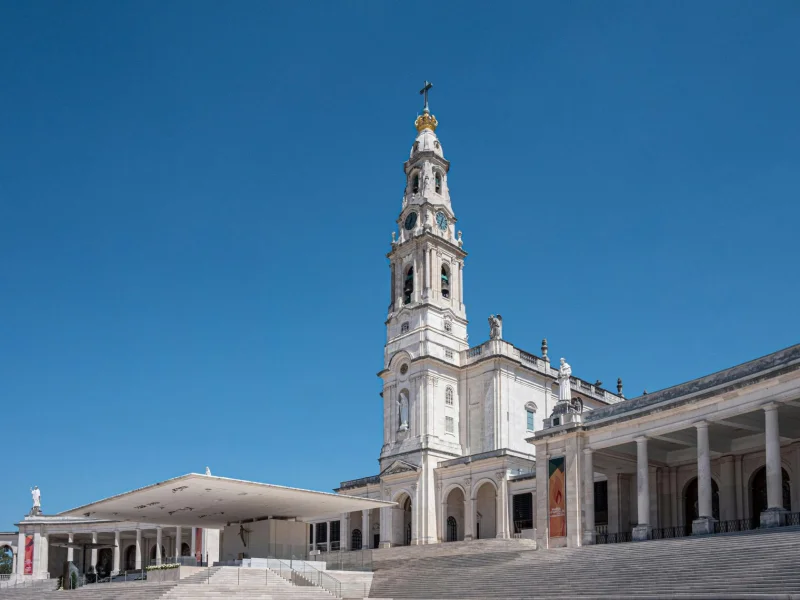
May 13 is the Feast of Our Lady of Fatima, a date that takes the Church back to May 13, 1917, when Our Lady first appeared to Lucia, Jacinta and Francisco, three shepherd children tending their flock and playing together in the hills of Portugal.
The children said she appeared to them as more brilliant than the sun. Her first words were a plea that has echoed across generations: pray, pray very much. Make sacrifices for sinners. She then asked the three shepherd children whether they wished to offer themselves to God to endure sufferings as an act of reparation and supplication for the conversion of sinners. When they answered, she told them they would have much to suffer, but that the grace of God would be their comfort.
Her message at Fatima was not vague. She told them, “Pray the Rosary every day to obtain peace for the world and the end of the war.” That is why the feast still lands with force today. It is not just a commemoration of an apparition; it is a reminder of a spiritual program built around prayer, sacrifice and peace, and it comes on the same day the Church also marks the Feast of Our Lady of the Blessed Sacrament.
That connection runs deeper than a calendar coincidence. The Feast of Our Lady of the Blessed Sacrament falls on May 13 because that was the day St. Peter Julian Eymard founded the Congregation of the Most Blessed Sacrament. He taught his novices to pray, “Our Lady of the Blessed Sacrament, pray for us who have recourse to thee.” The article presents Fatima devotion and Eucharistic devotion as linked: one calling believers to the Rosary, the other to a greater love and fidelity to the Eucharist.
Fatima also did not begin with the apparition itself. Before meeting Our Lady, the children of Fatima had three encounters with the Angel of Peace. In the final meeting, the Angel held a Host over a chalice suspended in mid-air and prayed three times before the Eucharistic miracle. The prayer placed adoration, reparation and conversion at the center of the story long before May 13, 1917, and it prepared the children for what came next.
The Angel of Peace prayed: “Most Holy Trinity, Father, Son and Holy Spirit, I adore You profoundly. I offer You the most precious Body, Blood, Soul and Divinity of Jesus Christ, present in all the tabernacles of the world in reparation for the outrages, sacrileges, and indifference by which He is offended. And, through the infinite merits of the Sacred Heart of Jesus and the Immaculate Heart of Mary, I beg of You the conversion of sinners.” In the Fatima account, that prayer is not an ornament. It is the frame around the apparitions that follow.
May itself helps explain why the feast sits where it does. The month is filled with Marian feasts, including Our Lady, Queen of the May on May 1 and the Feast of the Visitation on May 31. Within that span, Fatima stands out as one of the most important Marian apparitions of all time, not only because of what the children saw, but because of what they were told to do: pray, offer sacrifice, and ask for peace.
On a day marked by the Church calendar, the message remains direct. Our Lady of Fatima asked for prayer without delay, sacrifice without hesitation and a Rosary said every day for peace and for the end of war. That is the heart of the feast, and it is why May 13 still matters.