


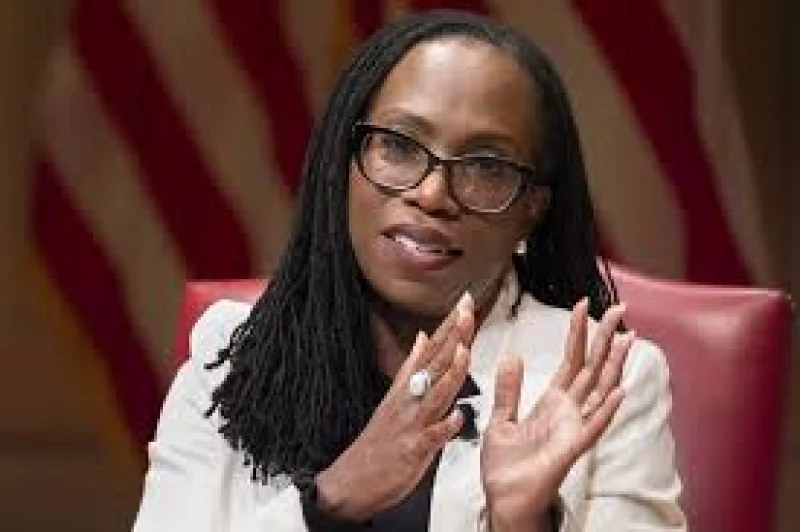
Justice Ketanji Brown Jackson broke with her Supreme Court colleagues this week over an order that will speed up efforts to redraw congressional maps and weaken a key part of the Voting Rights Act. In a sharp dissent, Jackson said the court improperly dove into the fray of active elections by handing down its judgment immediately.
Jackson wrote that the court was “not content to have decided the law, it now takes steps to influence its implementation.” The line captured the force of her complaint: the justices did not just rule on Louisiana’s map, they moved up the timing in a way that could shape how quickly several red states try to put new congressional lines in place.
The dispute comes after the court last month struck down Louisiana’s map, finding 6-3 that it contained an unconstitutional racial gerrymander. This week, the justices voted 8-1 to fast-track the decision and issue it immediately rather than wait roughly a month, a move that gave states more time to act before the political calendar moved on.
That timing matters because the ruling also limited the role race may play in congressional redistricting, weakening Section 2 of the Voting Rights Act in the process. For Jackson, the court’s decision to accelerate the opinion was not a procedural footnote but a choice with real consequences for elections already in motion.
Justice Samuel Alito, joined by Justices Clarence Thomas and Neil Gorsuch, responded with a concurrence that accused Jackson of going too far. Alito called her claims “groundless and utterly irresponsible,” underscoring just how sharply the court split over both the substance of the voting-rights ruling and the way it was released.
The disagreement fits a pattern. Jackson and the court’s other liberal justices have remained unified against the Trump administration in a string of cases involving universal injunctions, transgender medical treatments for minors, firings of members of independent agencies and temporary protected status. Jackson has also repeatedly criticized the court for not asserting more judicial authority over President Donald Trump’s executive actions.
The same conservative bloc that backed the voting-rights ruling also took another major step this week, voting 6-3 to ban nationwide injunctions against Trump’s plan to severely limit birthright citizenship. Jackson issued a separate dissent in that case too, leaving her once again at odds with a majority that is willing to move fast, act broadly and leave little doubt about where it wants the law to land.
The immediate question now is not whether Jackson will keep dissenting; she will. It is whether the court’s willingness to speed up decisions in politically charged cases has become part of the power it is prepared to wield.