


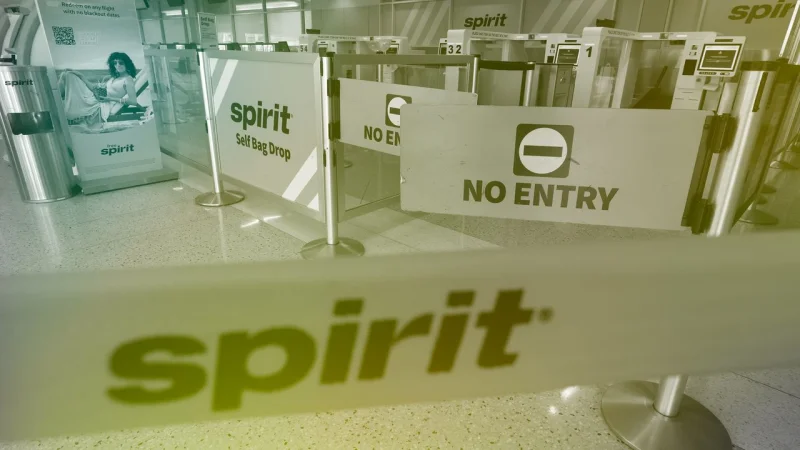
Spirit Airlines abruptly shut down on May 2 after the collapse of a federal rescue effort, ending the life of an ultra-discount carrier that had already been staggered by debt, losses and two bankruptcy filings in 2024 and 2025.
The airline’s electronic arrivals screen at LaGuardia showed cancelled Spirit flights from Fort Lauderdale, Chicago, Miami, Dallas-Fort Worth, Houston, Myrtle Beach and Detroit, a sudden disappearance that hit one of the carrier’s New York touchpoints where it had moved into the Marine Air Terminal in 2021.
The shutdown lands at a moment when Spirit had been trying to convince creditors, workers and regulators that it could still survive. Earlier this year, the carrier hoped to emerge from court supervision and return to profit in 2027, but that plan was overtaken by rising costs and a financing fight that left it with little room to maneuver. Spirit had not turned a profit since before the COVID-19 pandemic, and between the end of February and early April the price of jet fuel rose by more than ninety per cent. Its losses grew and its cash pile shrank after the Iran war, tightening the squeeze on a company already carrying heavy debt.

The aborted rescue became political last month when Trump floated the idea of the federal government rescuing Spirit and taking a big ownership stake. Some of the airline’s creditors reportedly balked at the prospect of having their claims subordinated to the U.S. government, and the effort lost momentum. That left Spirit exposed to the same forces that had been pressuring it for months: a weak balance sheet, a costly fuel bill and a business model built on bare-bones fares.
For major carriers, the shutdown is likely to be welcome news. United, in particular, had an urgent financial interest in seeing the back of Spirit as a cheap competitor. But the end of Spirit is not automatically good news for everyone who flies. The airline’s ultra-discount fares had become part of the market for travelers who depend on the lowest possible prices, and those passengers now lose one of the few carriers built around that promise.
Spirit’s base at LaGuardia was also part of a longer aviation story. The Marine Air Terminal opened in 1940 and was designed by William Delano. Pan Am once used it for transcontinental propeller-powered seaplanes called Boeing 314 Clippers, and after Pan Am went out of business in 1991, Delta took over its shuttle service. Spirit’s arrival there in 2021 was only the latest chapter at a terminal that has served multiple airlines and shuttle operations for generations.
Steven Rattner captured the mood among the airline’s critics with a blunt line: “Let Spirit liquidate and add its tombstone to the airline graveyard.” With the shutdown now complete, that is effectively where Spirit has landed.