


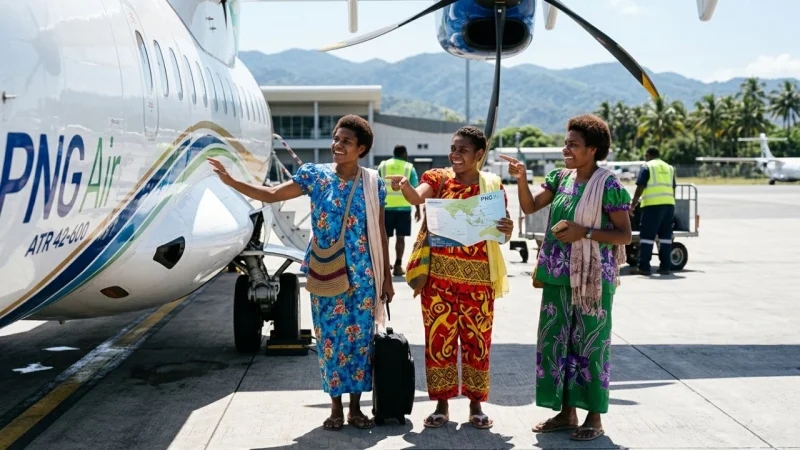
PNG Air has officially taken delivery of its first ATR42-600, a 48-seat turboprop built for the kind of flying that defines Papua New Guinea.
The aircraft is expected to help the carrier reach remote destinations more reliably, with fewer canceled flights and better access for travelers heading to places such as the Kokoda Trail, Milne Bay and the Mount Hagen Cultural Show.
That matters because papua new guinea is one of the most difficult aviation environments on Earth. Its rugged terrain, volcanic mountains, dense rainforests and far-flung tropical islands leave pilots regularly threading through high-altitude terrain, fast-moving tropical weather and extremely short runways, some of them unpaved. Standard regional jets cannot operate in that environment, which is why aircraft like the ATR42-600 remain central to domestic flying.
The new plane is designed for those conditions. Its powerful turboprop engines allow steep climbs out of deep valleys, while its short takeoff and landing performance is suited to challenging strips with limited infrastructure. The aircraft also has advanced aerodynamics meant to support safer landings on airstrips that offer little margin for error.
Inside, the ATR42-600 comes with the Armonia cabin, which offers wider seats, larger overhead bins and better acoustic insulation than older regional aircraft. For passengers, that should make short flights feel less punishing. For the airline, it could mean a more dependable schedule on routes where weather and terrain already make every departure a gamble.
The timing is important for tourism and connectivity. The aircraft is intended to improve access to remote destinations and strengthen links that can support cargo movement as well as passenger travel. Its advanced avionics are also expected to help crews operate more safely in marginal weather, a practical advantage in a country where disrupted schedules can ripple far beyond one route.
The delivery gives PNG Air a tool better matched to the country it serves. Whether it can turn that into a steadier network will depend on how often the weather, the terrain and the runway conditions allow the plane to do what it was built for.