


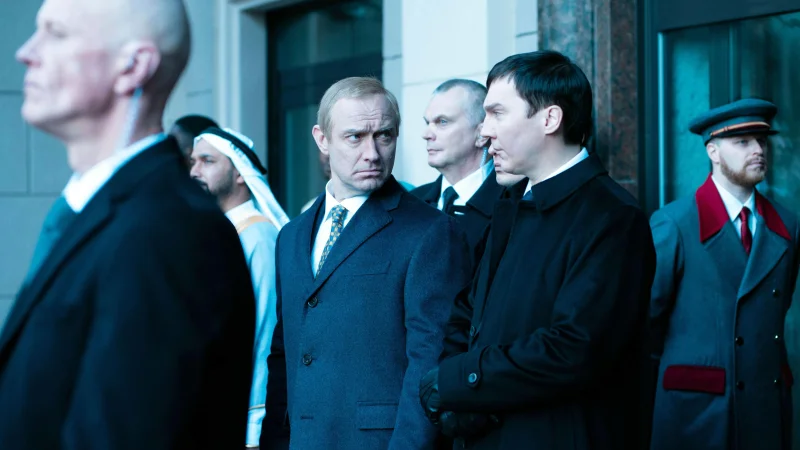
Paul Dano plays Vadim Baranov in The Wizard of the Kremlin, Olivier Assayas’s two-and-a-half-hour political thriller about the birth of Putinism. Last month, the film arrived in cinemas with a story that begins in the roaring 90s and ends at the annexation of Crimea in 2014.
Baranov is the fictional “Wizard” of the title, a whizkid theatre and television executive who is tasked with creating and curating a successor to the ailing Boris Yeltsin. Dano gives him a whispering, confiding monotone, playing the character as a man who seems to be thinking several moves ahead while saying almost nothing out loud. The role has been described as “the greasy-faced young preacher from There Will Be Blood,” and the comparison fits the unsettling calm he brings to the part.
The film is based closely on Giuliano da Empoli’s 2022 book The Wizard of the Kremlin and is framed as a story within a story. Jeffrey Wright plays an American academic who arrives in Moscow for a sabbatical of literary research. He is contacted by an anonymous fan, taken by black Mercedes to a remote wooded dacha, and there listens as Baranov recounts his life story.
That structure gives the film its momentum, turning a political saga into a private confession. The route from the decay of Yeltsin’s presidency to the consolidation of power around Vladimir Putin runs through oligarchs such as Boris Berezovsky, and the film keeps that connection in view as it moves across one of modern Russia’s most volatile periods. Jude Law plays President Putin, Will Keen appears as Berezovsky, and Magne-Havard Brekke channels Eduard Limonov.
Baranov is modelled on spin doctor Vladislav Surkov, and the film never pretends otherwise. Olivier Assayas and co-scriptwriter Emmanuel Carrère use that figure to explore how image-making and politics became inseparable in the Kremlin years, with Carrère also making a brief cameo as a French intellectual. The result is a fictional political thriller that treats the rise of Putin not as a single event but as a system taking shape in public and then hardening in private.
Baranov’s own lines make the point with bleak clarity: “In Russia, things generally go quite well,” he says. “But when they go bad, they go really bad.” Later, he adds, “I know that Russia has always been forged this way – with an axe.” By the end, the film answers its own question plainly. The point is not just how power was built, but how quickly it could be normalized once the machinery was in place.