


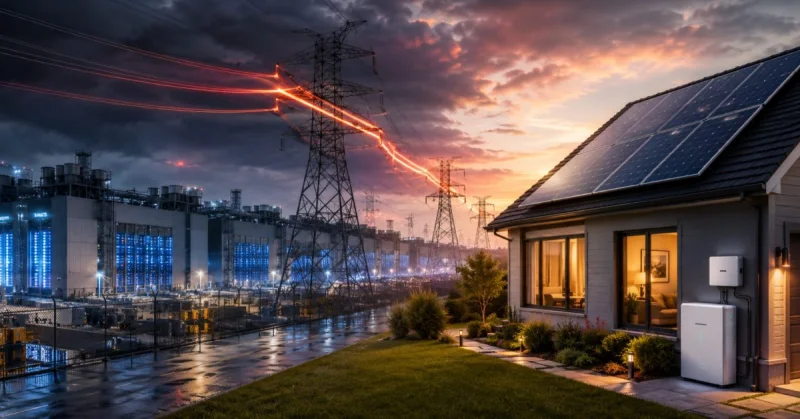
For decades, NV Energy supplied most of the power that kept Lake Tahoe lit, heated and running. Now the Nevada utility has told 49,000 residents that 75% of that electricity supply is being redirected to data centers, and that it will stop providing power to Liberty Utilities after May 2027.
The notice lands with unusual force because it does not describe a distant grid problem. It means the small California company that serves the Lake Tahoe region will have to replace a utility that has long carried the bulk of the area’s electricity. NV Energy said it needs the capacity for data centers being built by Google, Apple and Microsoft around the Tahoe-Reno Industrial Center east of Reno, where demand has become so large that it is now reshaping who gets power and when.
The numbers show how quickly the pressure is building. Data centers consumed 22% of Nevada’s electricity in 2024, and state forecasts put that share at 35% by 2030. Twelve data center projects in Northern Nevada could drive 5,900 megawatts of new demand by 2033, while about 75% of major-project load growth in NV Energy’s 2024 filing was attributed to data centers. That shift is not isolated to Nevada either: AI data centers are expected to triple their share of U.S. electricity consumption from 4.4% in 2023 to 12% by 2028, and data centers drove half of all U.S. electricity demand growth last year.

The Lake Tahoe cutoff also comes at a moment when households across the country are already feeling the strain of a tighter power system. The national average residential electricity rate reached 17.45 cents per kilowatt-hour in January 2026, up 9.5% from a year earlier. In Virginia, Dominion Energy proposed its first base-rate increase since 1992, a move that would add about $8.51 a month in 2026. At the same time, Google said it spent $4.75 billion last year chasing power for its AI data centers, a sign of how aggressively big technology companies are competing for electricity.
Homeowners are responding in the way many do when rates rise and reliability feels less certain: by looking at their own rooftops and batteries. But that market is also changing fast. Congress eliminated the 30% federal tax credit for customer-owned residential solar systems at the end of 2025, and residential solar installations are expected to decline 18% in 2026. Third-party ownership models, meanwhile, are projected to grow 25% in 2026 and capture up to 69% of residential installations, up from roughly 45% in 2025.
So the question in Lake Tahoe is no longer whether data centers are changing the grid. They already are. The immediate issue is whether residents who have depended on one utility for decades can secure enough new power before May 2027, or whether the region’s electricity future will be set first by the demands of cloud computing and artificial intelligence.